


CMS posts March 2026 enrollment report: ~5.2 MILLION fewer Americans have Medicaid/CHIP coverage since Trump returned
Thu, 07/23/2026 - 11:30am
The Trump Regime has published an update to the official Medicaid/CHIP enrollment data:
March 2026 Key Findings
Medicaid and CHIP Enrollment
- In March 2026, 74.3 million individuals were enrolled in Medicaid and CHIP.
- 67.1 million individuals were enrolled in Medicaid, and 7.2 million individuals were enrolled in CHIP.
- 38.7 million adults were enrolled in Medicaid, and there were 35.6 million Medicaid child and CHIP enrollees.
Total Medicaid/CHIP enrollment in March 2025 dropped about 1.5% from February 2026, or over 1.1 million people.
The all-time high enrollment watermark for Medicaid/CHIP was in April 2023, when it officially hit 94.1 million Americans (95.7 million when you include the U.S. territories).
It's important to note that CMS actually has two different reports on Medicaid enrollment: The monthly Medicaid & CHIP Enrollment Trend Snapshot (referenced above) and the Medicaid Budget & Expenditure System (MBES).
Each type of report measures Medicaid enrollment a bit differently:
- The MBES report is a year out of date (through June 2025) while the Trend Snapshot is only 4 months out of date (through March 2026).
- The MBES count includes individuals enrolled in limited benefit plans and the Performance Indicator count does not include such individuals.
- The MBES data represents the count of unduplicated individuals enrolled in the state’s Medicaid program at any time during each month in the quarterly reporting period, while the Performance Indicator data captures the count of individuals enrolled on the last day of the month.
- The MBES count only includes individuals whose coverage is funded through Medicaid (title XIX of the Social Security Act), while the published Performance Indicator also includes individuals funded through CHIP (title XXI of the SSA).
- MBES and Performance Indicator data may be derived from different state systems.
- Retroactive state adjustments to MBES or Performance Indicator data may be in progress.
- States have likely generated MBES data and Performance Indicator data from state systems on different dates.
- The other major difference: The MBES reports include Medicaid enrollees in the U.S. territories: American Samoa, Guam, N. Mariana Islands, Puerto Rico and the U.S. Virgin Islands.
The MBES numbers for U.S. territories stood at 1.44 million Medicaid enrollees as of June 2025. If you add those to the Trend Snapshot total for the 50 states +DC, it comes in at 75.7 million as of March 2026.
It's also worth noting that ACA Medicaid Expansion enrollment specifically was 20.4 million as of June 2025 according to the MBES report, down around 3.6 million from the all-time high it reached in May 2023.
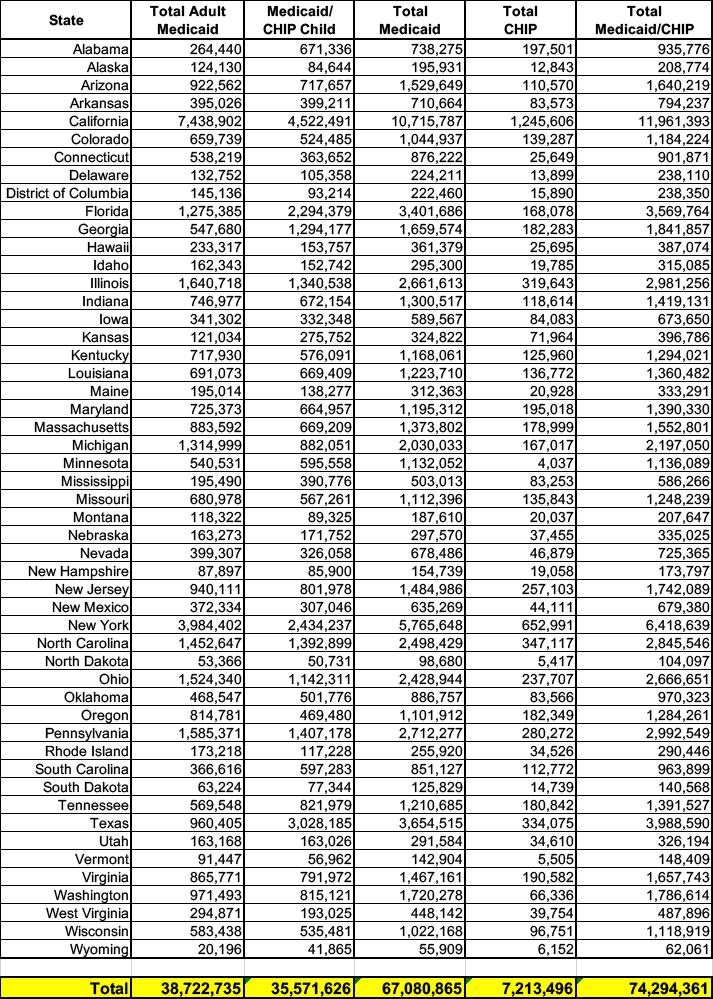
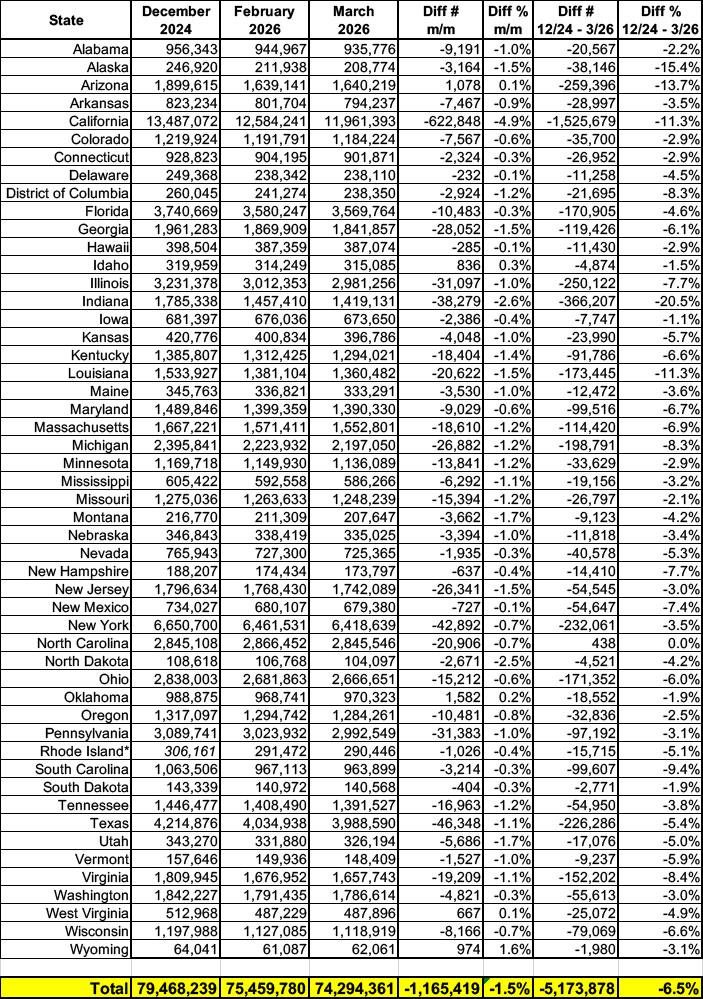
Between December 2024 (the last full month before Trump took office again) and March 2026, net Medicaid/CHIP enrollment has dropped by nearly 5.2 million, or 6.5%.
This ranges from virtually no net enrollment change at all in North Carolina to as much as a 20.5% drop in Medicaid/CHIP enrollment in Indiana, where there are 366,000 fewer Hoosiers enrolled in either program than at the beginning of Trump 2.0.
In terms of raw numbers, the largest decline in enrollment is California, as you'd expect, where over 1.5 MILLION residents have been removed from the Medicaid/CHIP rolls since December 2024 (an 11.3% drop).
Of course, Medicaid/CHIP enrollment dropping isn't necessarily a bad thing if the reason is because those folks instead moved to other types of comprehensive healthcare coverage instead such as individual coverage (ACA marketplace), Medicare or employer-sponsored coverage. However, given what's happening with the ACA marketplace this year and that 200,000 more Americans were unemployed in June 2026 vs. December 2024, that's not terribly comforting.
Medicare enrollment, on the other hand, has gone up by over 1.3 million since January 2025, which does cancel out some of the Medicaid/CHIP losses...except that most of those additional Medicare enrollees didn't shift from Medicaid/CHIP. Most of them aged out from employer coverage, while some turned 65 and transitioned from ACA policies or other types of healthcare coverage.
Advertisement


