


2027 Rate Changes - Nevada: +17.2% indy market; +12.3% sm. group market (FINAL)
Thu, 09/17/2026 - 8:35pm
Originally posted 8/20/2026
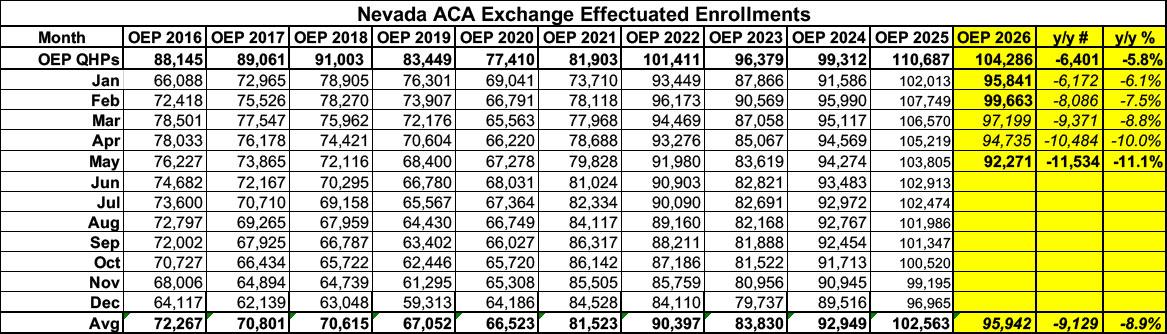
ACA exchange enrollment has dropped by 11% in Nevada since Congressional Republicans allowed the enhanced federal subsidies to expire at the end of last year.
Initial signups during Open Enrollment were only down ~6% vs. OEP 2025...but effectuated enrollment has gradually shrunk further every month since then and stood at 11.1% lower as of May 2026.
That's over 11,000 Nevadans who have lost coverage so far this year.
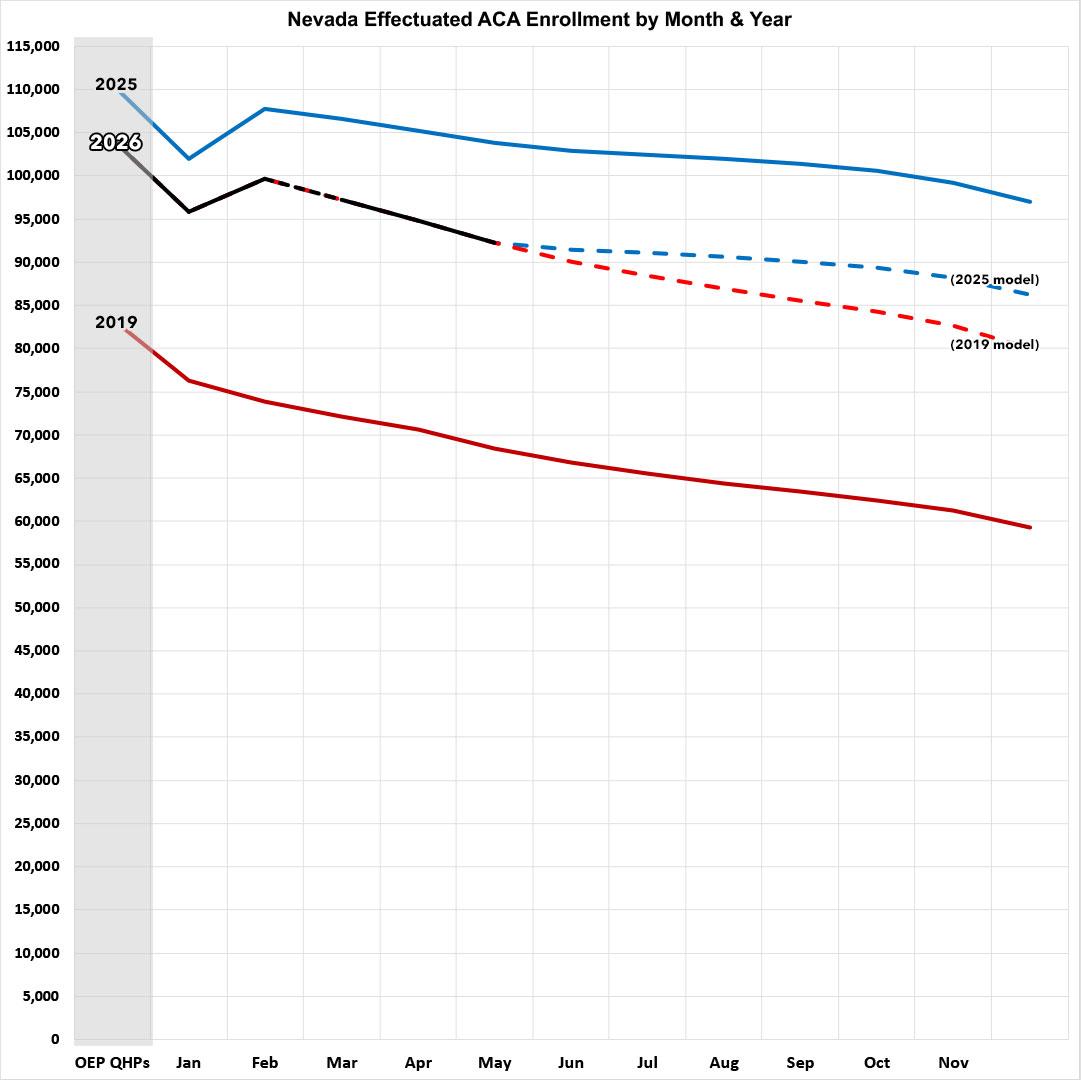
Here's what this looks like visually, with both 2025 and 2019 (the last pre-COVID year, which didn't include the enhanced subsidies) included for comparison:
Looking ahead to 2027, the preliminary rate filings for both the individual and small group markets are now available via the federal Rate Review database:
CARESOURCE:
This document contains the Part II written description justifying the rate increase subject to review on CareSource Nevada Co’s (CNV) individual medical block of business in Nevada, effective January 1, 2027. The average proposed rate increase is 25.7% and varies based on age, geographic region, and plan selection. There are 799 members currently enrolled that will be affected by the rate change.
Both costs and the number of services for medical and pharmacy benefits have increased significantly, which is the major contributor to this rate action. Changes in benefits are not a major contributor to the rate action and are within the bounds defined by CMS’ Final AV Calculator instructions. The expiration of ARPA and the resulting assumed reduction in total marketplace membership is a driver of increased administrative expenses in this filing.
COMMUNITY CARE:
Community Care Health Plans of Nevada dba Anthem Blue Cross and Blue Shield has made an application to the Nevada Department of Insurance for premium rate changes for its fully ACA‐compliant individual health plan products. This increase will impact approximately 5,100 Nevada insured members renewing on 1/1/2027 with Community Care Health Plans of Nevada dba Anthem Blue Cross and Blue Shield. At the individual plan level, rate increases range from 4.4% to 15.3% with an average increase of 9.3%. A subscriber’s actual rate could be higher or lower depending on the geographic location, age characteristics, dependent coverage and other factors.
Financial Experience
Community Care Health Plans of Nevada dba Anthem Blue Cross and Blue Shield expects the proposed rate increase will cover projected medical trends and yield a medical loss ratio of 86.5%, meaning more than eighty-six cents of each premium dollar is expected to go to covering our members’ medical expenses and improving health care quality. This projected MLR of 86.5% exceeds the minimum MLR requirement of 80% as defined in the Affordable Care Act (ACA). In the event Community Care Health Plans of Nevada dba Anthem Blue Cross and Blue Shield’s MLR is less than the Federal required minimum for a three year period, Anthem will refund the difference to policyholders, consistent with federal regulations.
Drivers of Rate Increase
The primary drivers of premium increases are associated with increased cost of benefit expense for this ACA compliant block. Increased cost of benefit expense is driven by increases in the price of services primarily from hospitals, physicians and pharmacies, coupled with members increasing their use of health care services, also called “utilization”.
Increases in the price of services are driven by technological advances, new specialty medications, and a variety of other factors. Increased utilization is driven by member level utilization and selection patterns in the Guaranteed Issue, Community Rated ACA market.
Efforts to Control Costs
Community Care Health Plans of Nevada dba Anthem Blue Cross and Blue Shield is committed to working to hold down the cost of insurance and price the Individual ACA market for long term sustainability. We continue to explore innovative collaboration with providers and negotiate deeper discounts at our hospitals and we provide members with tools to make informed decisions about where and how to receive treatment.
HEALTH PLAN OF NV:
The following memorandum describes the key drivers of the rate changes of individual rates for Health Plan of Nevada, Inc. (“HPN”). HPN policies are individual medical plans offered in Nevada and are fully compliant with the Patient Protection and Affordable Care Act.
Scope and Range of the Rate Increase
HPN is filing 2027 rates for individual products. The proposed rate change is 21.73% and will affect 44,110 individuals. The rate changes vary between 10.04% and 37.74%. Given that the rate changes are based on the same single risk pool, the rate changes vary by plan due to plan design changes.
Financial Experience of the Product
The premium collected in plan year 2025 was $268,263,115. Incurred claims net of reinsurance during this period were $225,391,200.00 and HPN expects payments of $26,510,309 for risk adjustment. The loss ratio, or portion of premium required to pay medical claims, for plan year 2025 is 93.23%.
Changes in Medical Service Costs
There are many different healthcare cost trends that contribute to increases in the overall U.S. healthcare spending each year. These trend factors affect health insurance premiums, which can mean a premium rate increase to cover costs. Some of the key healthcare cost trends that have affected this year’s rate actions include:
- Increasing cost of medical services: Annual increases in reimbursement rates to healthcare providers, such as hospitals, doctors, and pharmaceutical companies.
- Increased utilization: The number of office visits and other services continues to grow. In addition, total healthcare spending will vary by the intensity of care and use of different types of health services. The price of care can be affected using expensive procedures such as surgery versus simply monitoring or providing medications.
- Higher costs from deductible leveraging: Healthcare costs continue to rise every year. If deductibles and copayments remain the same, a higher percentage of healthcare costs need to be covered by health insurance premiums each year.
- Impact of new technology: Improvements to medical technology and clinical practice often result in the use of more expensive services, leading to increased healthcare spending and utilization.
- Changes in market morbidity: Expanded and enhanced federal premium tax credits for consumers expired at the end of 2025. Premiums reflect the expected increase in average cost per member due to healthier members leaving the market.
Changes in Benefits
Changes in benefits impact costs and therefore affect premium changes. Plan benefits are typically changed for one of three reasons: to comply with the requirements of the Affordable Care Act or state law, to respond to consumer feedback, or to address a particular medical cost issue to provide greater long-term affordability of the product.
The Affordable Care Act implemented requirements for the “value” that must be offered by plan designs in the Individual and Small Group markets. These are called “metal levels”. For a benefit plan to remain classified within a particular metal level from year to year, adjustments to deductibles, copayments or coinsurance are sometimes required. These adjustments impact the cost and therefore the premium increases for the plan.
Administrative Costs and Anticipated Margins
HPN works to directly control administrative expenses by adopting better processes and technology and developing programs and innovations that make healthcare more affordable. We have led the marketplace by introducing key innovations that make healthcare services more accessible and affordable for customers, improve the quality and coordination of healthcare services, and help individuals and their physicians make more informed healthcare decisions.
Taxes and fees imposed by the state and federal government are significant factors that impact healthcare spending and must be included as additional administrative costs associated with the plans. These fees include Affordable Care Act taxes and fees which impact health insurance costs and need to be reflected in premium. Another component of premium is margin, which is set to address expected volatility and risk in the market. The requested rate change is anticipated to be sufficient to cover the projected benefit and administrative costs for the 2027 plan year.
HMO COLORADO DBA HMO NEVADA:
The proposed annual rate changes by product in this filing range from XXXXX to XXXXX, with rate changes by plan from XXXXX to XXXXX. These ranges are based on the renewing plans, and are consistent with what is reported in the Unified Rate Review Template. Exhibit A shows the rate change for each plan. The average rate increase is XXXXX. Exhibit A1 shows the walkdown of the major components of the rate change. The proposed rate change results in an expected average annual premium of XXXXX PMPM and impacts XXXXX current policyholders and covered lives.
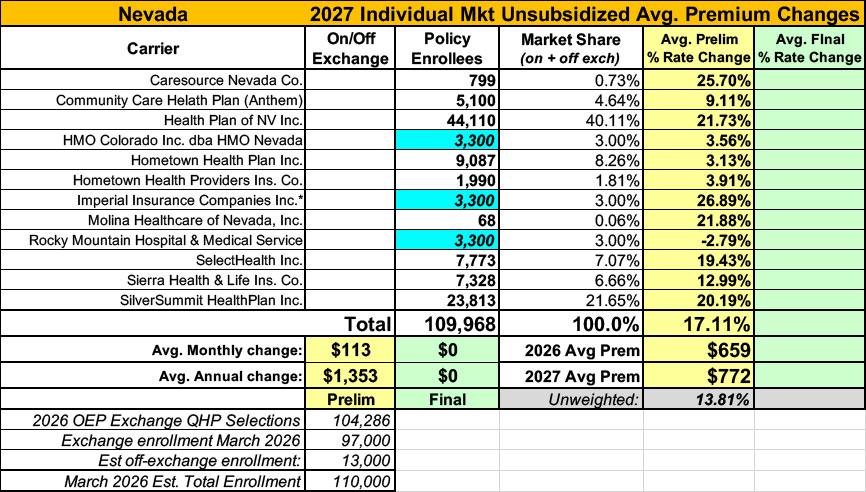
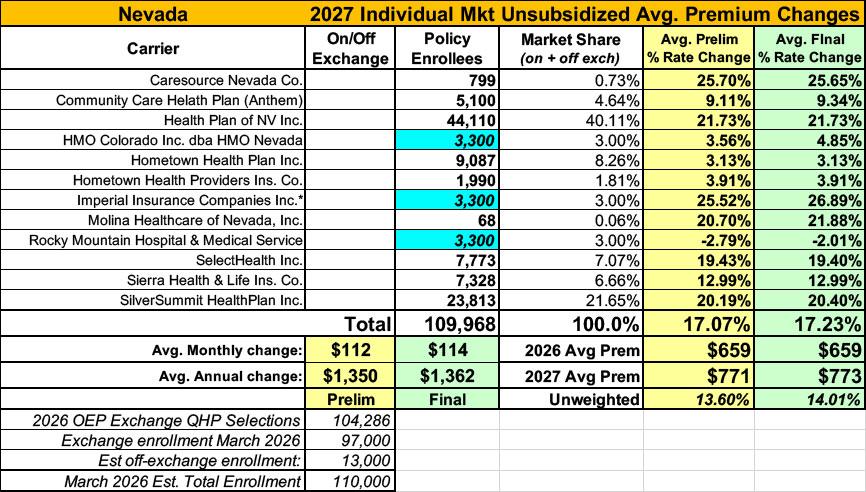
(As you can see, HMO Nevada has heavily redacted their actuarial memo, making it impossible to run a fully weighted average)
HOMETOWN HEALTH PLAN:
The average rate change from January 1, 2026 to January 1, 2027 is 3.1%. The average change for a given plan ranges from -1.0% to 9.7%. The increase will impact 9,087 individuals. The primary factors causing a range of rate changes are as follows:
- Removal of a 3% load to 2026 rates for all plans that was required by the NV DOI due to a change in the de minimis range after initial rates were filed for the 2026 plan year.
- The actuarial value of each 2026 plan and the renewing 2027 plan were not equal. The change in the actuarial value was not consistent by plan due to differing benefit changes.
- Some plans were terminated at the end of 2026 and these plans were mapped to a continuing 2027 plan in the same, or closest, metal level for rate change calculation purposes.
- The pricing paid to allowed ratios were updated for 2027. Oliver Wyman’s pricing model was calibrated to the 2027 projected Index Rate and enhancements have been made since the 2026 pricing.
- Differentials in observed costs by rating region were not consistent with those anticipated in the 2025 rates.
Further, the impact of negotiated changes in provider reimbursement differs between rating regions.
FINANCIAL EXPERIENCE OF THE PRODUCT
Hometown Health Plan Inc.’s individual experience had a risk adjusted loss ratio of 85.3% on $49.9M of premium as shown in the Uniform Rate Review Template for the 2027 plan year filing. This experience reflects 72,175 member months which we do not consider fully credible.
CHANGES IN MEDICAL SERVICE COSTS
The medical utilization and pharmacy utilization/unit cost annual trend rates were used to project claims from the experience period to the rating period. These values were developed based on an analysis of Hometown’s monthly historical combined individual and small group lines of business allowed claims experience over the time period of January 1, 2023 to December 31, 2025, with runout through March 31, 2026. The experience represents a total of 439,363 member months. The medical unit cost trends were based on an analysis of known and projected provider contract changes between the experience and projection periods. The annual trends (unit cost plus utilization) are estimated to be 7.2% for medical services and 9.1% for pharmacy services.
CHANGES IN BENEFITS
The proposed plans for these products remained within the same metal tier.
ADMINISTRATIVE COST CHANGES
Changes in administrative costs were driven by an updated review of the budgeted administrative expenses, commissions, and private reinsurance costs.
HOMETOWN HEALTH PROVIDERS:
The average rate change from January 1, 2026 to January 1, 2027 is 3.9%. The average change for a given plan ranges from 3.1% to 5.3%. The rate change will impact 1,990 individuals. The primary factors causing a range of rate changes are as follows:
- Removal of a 3% load to 2026 rates for all plans that was required by the NV DOI due to a change in the de minimis range after initial rates were filed for the 2026 plan year.
- The actuarial value of each 2026 plan and the renewing 2027 plan were not equal. The change in the actuarial value was not consistent by plan due to differing benefit changes.
- Some plans were terminated at the end of 2026 and these plans were mapped to a continuing 2027 plan in the same, or closest, metal level for rate change calculation purposes.
- The pricing paid to allowed ratios were updated for 2027. Oliver Wyman’s pricing model was calibrated to the 2027 projected Index Rate and enhancements have been made since the 2026 pricing.
- Differentials in observed costs by rating region were not consistent with those anticipated in the 2026 rates.
Further, the impact of negotiated changes in provider reimbursement differs between rating regions.
FINANCIAL EXPERIENCE OF THE PRODUCT
Hometown Health Provider Insurance Company’s individual experience had a risk adjusted loss ratio of 88.8% on $16.9M of premium as shown in the Uniform Rate Review Template for the 2027 plan year filing. This experience reflects 16,588 member months, which we do not consider fully credible.
CHANGES IN MEDICAL SERVICE COSTS
The medical utilization and pharmacy utilization/unit cost annual trend rates were used to project claims from the experience period to the rating period. These values were developed based on an analysis of Hometown’s monthly historical combined individual and small group lines of business allowed claims experience over the time period of January 1, 2023 to December 31, 2025, with runout through March 31, 2026. The experience represents a total of 439,363 member months. The medical unit cost trends were based on an analysis of known and projected provider contract changes between the experience and projection periods. The annual trends (unit cost plus utilization) are estimated to be 7.1% for medical services and 9.1% for pharmacy services.
CHANGES IN BENEFITS
The proposed plans for this product remained within the same metal tier.
ADMINISTRATIVE COST CHANGES
Changes in administrative costs were driven by an updated review of the budgeted administrative expenses, commissions, and net private reinsurance costs.
IMPERIAL INSURANCE:
Imperial Insurance Companies, Inc. (Imperial) has submitted its 2027 filing for its Individual HMO product. The weighted average premium increase is 25.52%, with a minimum and maximum increase by plan of 14.38% and 29.28% respectively.
Key Drivers for this Filing
Experience:
Since Imperial had no experience in the experience period, the projected 2027 claims and resulting premiums were developed based on publicly available URRT data from Nevada Individual market carriers was aggregated and thus the manual rate is based on the entire single risk pool for Nevada’s Individual market.
Changes in Medical Service costs:
A main driver of premium increases includes changes to anticipated medical costs and utilization of services. The assumed trend was 6.9%.
Risk Adjustment:
Imperial is projecting a risk adjustment payment of $90.00 PMPM on an allowed basis. It is assumed Imperial’s coding practices will lag competitors during the first few years of operation. Imperial’s mission is to support the healthcare needs of all Nevadans and believes the requested increase will help best meet those goals.
(Unfortunately, Imperial doesn't provide their enrollment tally either)
MOLINA HEALTHCARE:
Molina Healthcare of Nevada, Inc. is a managed care organization that provides healthcare services for individuals eligible for Medicaid, Medicare, and Marketplace throughout the State of Nevada. Molina is a licensed state health plan managed by its parent corporation, Molina Healthcare, Inc.
1. Scope and range of the rate increase: Molina’s proposed rates represent an average rate increase of 21.9% for the 68 Molina members enrolled in continuing plans effective March 2026. The proposed rate changes vary by metal tier. Members would receive premium increases of on average 21.9% and the rate increase would range from 15.9% to 22.5% depending on their geographic location, metal tier, and age.
2. Financial experience of the product: The financial experience of medical loss ratio was greater than 80% in 2025. Projected claims represent 30.7% of rate increase. The proposed premium rates would yield a medical loss ratio of greater than 80%. The medical loss ratio represents the percentage of every premium dollar that Molina expects to spend on medical expenses and improving health care quality for our members. The projected medical loss ratio is expected to not be credible with membership less than 1,000.
3. Changes in Medical Service Costs: Medical inflation related to the utilization and cost of covered services increased claims by 9.2%. Trend is one of the primary contributors to an increase in rates. Changes in provider contracting rates also contribute to the regional rate changes.
4. Changes in Benefits: Benefit changes in 2027 do not contribute much to the rate increase.
5. Administrative Costs and Anticipated Margins: Total administrative expenses are expected to represent 2.2% of rate increase. The targeted profit margin is 3.0% of premium
ROCKY MOUNTAIN:
Again, Rocky Mountain has heavily redacted their actuarial memo.
SELECTHEALTH:
Explanation of the Rate: SelectHealth is offering products in the Individual ACA plan market in 2027. These plans will be available in Clark and Nye counties. The requested rate change will impact approximately 7,773 members and will vary depending on age and plan selection. The 2027 average rate change is an increase of 19.4% with a minimum rate change of 17.9% and a maximum increase of 19.8%. SelectHealth has a goal of affordability. Our teams, combining provider systems and a health plan, are working together to achieve this objective.
Rate levels assume that the federal government will not be funding cost-sharing reduction subsidies. The primary drivers of the rate changes are the cost of medical services, deductible leveraging and new technology in medical services and pharmaceuticals.
The projected rates are made up of the following components:
- Claims: 80.2%
- Administrative Costs: 8.2%
- Federal Taxes and fees: 0.1%
- State taxes and fees: 6.1%
- Commissions: 2.4%
- Contribution to surplus, profit, and risk margin to account for variability of claims: 3.0%
SIERRA HEALTH & LIFE:
The following memorandum describes the key drivers of the rate changes of individual rates for Sierra Health and Life Ins Company, Inc. (“SHL”). SHL policies are individual medical plans offered in Nevada and are fully compliant with the Patient Protection and Affordable Care Act.
Scope and Range of the Rate Increase
SHL is filing 2027 rates for individual products. The proposed rate change is 12.99% and will affect 7,328 individuals. The rate changes vary between 11.16% and 16.03%. Given that the rate changes are based on the same single risk pool, the rate changes vary by plan due to plan design changes.
Financial Experience of the Product
The premium collected in plan year 2025 was $63,931,165. Incurred claims net of reinsurance during this period were $60,950,541 and SHL expects payments of $531,693 for risk adjustment. The loss ratio, or portion of premium required to pay medical claims, for plan year 2025 is 96.14%.
Changes in Medical Service Costs
There are many different healthcare cost trends that contribute to increases in the overall U.S. healthcare spending each year. These trend factors affect health insurance premiums, which can mean a premium rate increase to cover costs. Some of the key healthcare cost trends that have affected this year’s rate actions include:
- Increasing cost of medical services: Annual increases in reimbursement rates to healthcare providers, such as hospitals, doctors, and pharmaceutical companies.
- Increased utilization: The number of office visits and other services continues to grow. In addition, total healthcare spending will vary by the intensity of care and use of different types of health services. The price of care can be affected using expensive procedures such as surgery versus simply monitoring or providing medications.
- Higher costs from deductible leveraging: Healthcare costs continue to rise every year. If deductibles and copayments remain the same, a higher percentage of healthcare costs need to be covered by health insurance premiums each year.
- Impact of new technology: Improvements to medical technology and clinical practice often result in the use of more expensive services, leading to increased healthcare spending and utilization.
- Changes in market morbidity: Expanded and enhanced federal premium tax credits for consumers expired at the end of 2025. Premiums reflect the expected increase in average cost per member due to healthier members leaving the market.
Changes in Benefits
Changes in benefits impact costs and therefore affect premium changes. Plan benefits are typically changed for one of three reasons: to comply with the requirements of the Affordable Care Act or state law, to respond to consumer feedback, or to address a particular medical cost issue to provide greater long-term affordability of the product.
The Affordable Care Act implemented requirements for the “value” that must be offered by plan designs in the Individual and Small Group markets. These are called “metal levels”. For a benefit plan to remain classified within a particular metal level from year to year, adjustments to deductibles, copayments or coinsurance are sometimes required. These adjustments impact the cost and therefore the premium increases for the plan.
Administrative Costs and Anticipated Margins
SHL works to directly control administrative expenses by adopting better processes and technology and developing programs and innovations that make healthcare more affordable. We have led the marketplace by introducing key innovations that make healthcare services more accessible and affordable for customers, improve the quality and coordination of healthcare services, and help individuals and their physicians make more informed healthcare decisions.
Taxes and fees imposed by the state and federal government are significant factors that impact healthcare spending and must be included as additional administrative costs associated with the plans. These fees include Affordable Care Act taxes and fees which impact health insurance costs and need to be reflected in premium. Another component of premium is margin, which is set to address expected volatility and risk in the market. The requested rate change is anticipated to be sufficient to cover the projected benefit and administrative costs for the 2027 plan year.
SILVERSUMMIT HEALTHPLAN:
SilverSummit Healthplan Inc. is filing rates for the individual block of business, effective January 1, 2027. This document is submitted in conjunction with the Part I Unified Rate Review Template and the Part III Actuarial Memorandum.
This information is intended for use by the Nevada Division of Insurance, the Center for Consumer Information and Insurance Oversight (CCIIO), and health insurance consumers in Nevada to assist in the review of SilverSummit Healthplan Inc.’s individual rate filing.
The results are actuarial projections. Actual experience will differ for a number of reasons, including population changes, claims experience, and random deviations from assumptions. In 2025, earned premium was $563.02 per member per month (PMPM). Incurred claims in 2025 were $481.40, or 85.50% of premium. Netting risk adjustment from the claims results in an estimated loss ratio (incurred claims net of estimated risk adjustment transfers, divided by earned premiums) of 81.76%. We expect unit costs to increase for 2027. Further, we have updated underlying experience for the single risk pool, expected administrative expense, and assumptions for federal risk adjustment. These factors, as well as changes to the assumed morbidity of the single risk pool and medical trend, result in a premium rate increase.
Medical trend, or the increase in health care costs over time, is composed of two components: the increase in the unit cost of services and the increase in the utilization of those services. Unit cost increases occur as care providers and their suppliers raise their prices. Utilization increases can occur as people seek more services than before. Additionally, simple services can be replaced with more complex services over time, which is known as service intensity trend. An example of service intensity trend would be the replacement of an X-ray with an MRI scan. Replacing the service with a more intense service causes the total cost of medical services to increase.
The proposed rate change of 20.4% applies to approximately 23,813 individuals. SilverSummit Healthplan Inc.’s projected administrative expenses for 2027 are $92.75 PMPM. Administrative expense does not include $52.65 for taxes and fees. The historical administrative expenses for 2026 were $76.00 PMPM, which excludes taxes and fees. The projected loss ratio is 83.1% which satisfies the federal minimum loss ratio requirement of 80.0%.
Assuming my enrollment estimates for HMO Nevada, Imperial Insurance and Rocky Mountain are all reasonably close, the weighted average 2027 rate increase should be roughly 17.1% marketwide:
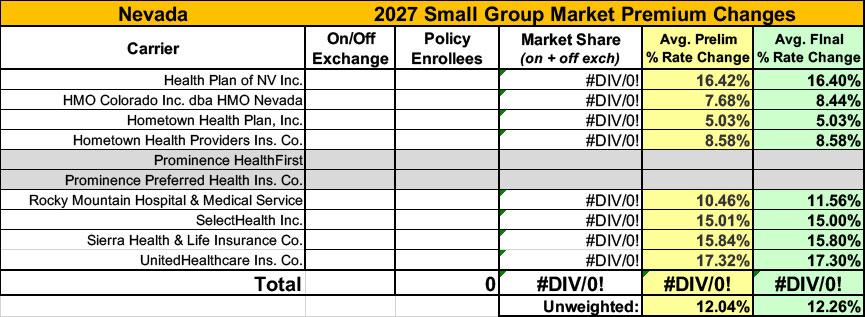
As for the Nevada small group market, those carriers are requesting an unweighted average increase of 12%:
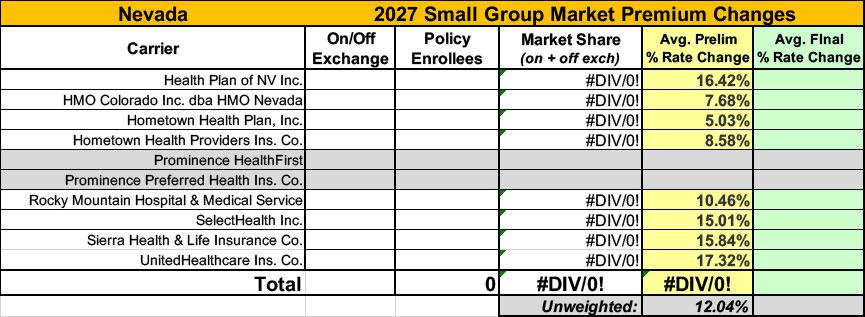
UPDATE 9/17/26: The Nevada Insurance Dept. has published the final, approved rate filings for the 2027 individual and small group markets. Overall only minor changes but the weighted average actually increased slightly, from 17.1% to 17.2% overall in the individual market, and from 12.0% to 12.3% for small group plans.
Advertisement


