


Mississippi: Want to see what the ACA looks like after a year of Trump & no mitigating factors in place?
Mon, 10/19/2026 - 3:56pm
When I last updated my "coverage loss" estimate a couple of weeks back, I noted that while I have hard effectuated enrollment data for Medicare and Medicaid as well as the CHIP and BHP programs, my estimates for ACA exchange enrollment have to rely on rough projections because:
...I could eliminate (or at least vastly narrow) the upper/lower bound estimates if CMS would actually update the actual Health Insurance Exchanges Monthly Effectuated Enrollment database, which is supposed to be updated monthly but which has been stuck at February 2026 for the past four months...
I think it's safe to say that this quote from Mississippi Insurance Commissioner Mike Chaney helps explain why the Centers for Medicare & Medicaid Services (CMS) have been a wee bit sluggish on updating their ACA exchange reporting:
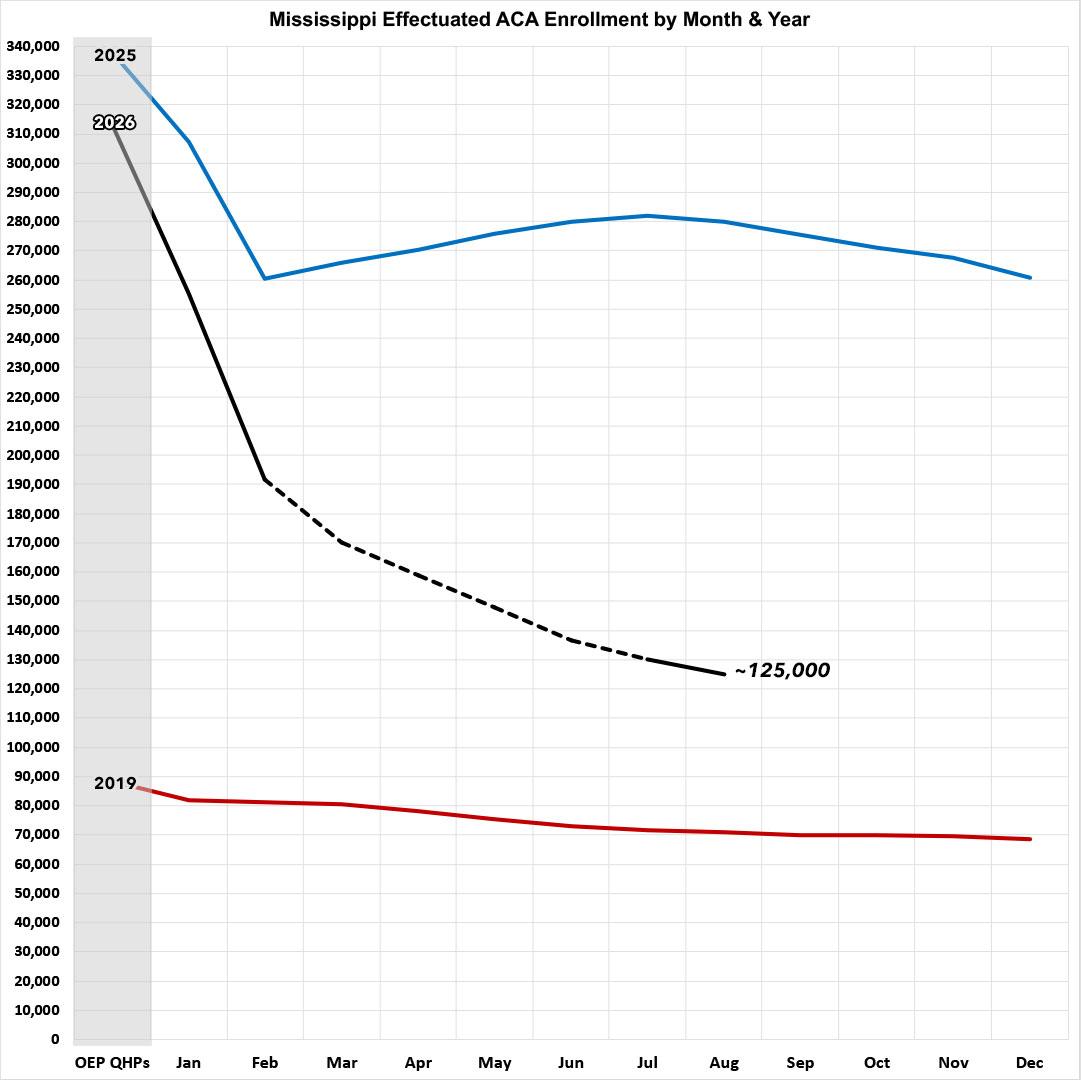
...Federal subsidies that helped make marketplace coverage affordable for many people have expired. Around 200,000 Mississippians opted out of their Marketplace coverage this year. Mississippi dropped from about 335,000 people enrolled in 2025 to around 125,000 who are still making payments as of August. Additionally, insurers are requesting substantial premium increases. Enrollees in the ACA Marketplace can expect to see an average rate increase of around 20% next year, depending on their carrier and plan. And some companies are leaving altogether. Molina Healthcare intends to withdraw from Mississippi’s federally run marketplace after this year, while Cigna is leaving Mississippi and every other state’s ACA exchange.
Now, the 20% average rate hike for unsubsidized enrollees isn't shocking to me; I actually had Mississippi's preliminary 2027 rate hikes down as 21% back in August.
The 125,000 effectuated as of August figure, however, is new. When I fill out my effectuated enrollment spreadsheet it looks like this...
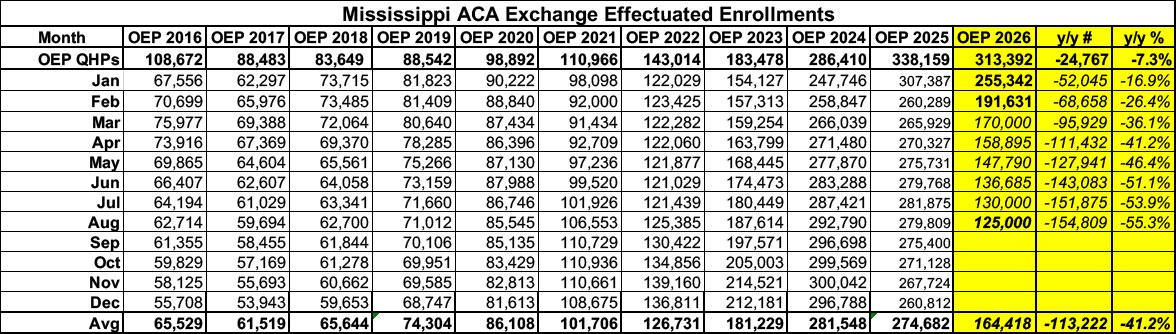
That's right: A stunning 55% drop in effectuated enrollment vs. the same month a year earlier. Here's what that looks like visually:
Mississippi is an important state to use here because, unlike most of the other states that I have more recent enrollment data for, the Magnolia State...
- HASN'T expanded Medicaid under the ACA
- DOESN'T operate their own ACA exchange
- DOESN'T offer their own supplemental financial subsidies
- DOESN'T have a Basic Health Plan (BHP) program in place for lower-income residents, and...
- DOESN'T have Premium Alignment pricing in place to help mitigate the damage.
In other words, Mississippi is a lot more representative of most states than those other states in terms of what the real-world impact of Trump/GOP policy changes over the past year and a half have been on effectuated ACA exchange enrollment.
To be clear: I'm not saying that every state fitting the above description has seen enrollment plummet by more than half, I'm just saying that I wouldn't be surprised if many of them have and if the others are close to it.
The rest of Chaney's op-ed is primarily focused on a stop-gap proposal to help mitigate the carnage in his state. To his credit, he's not gleefully cheering the gutting of the ACA marketplace or enthusiastically pushing for junk plans, and he's putting the blame exactly where it belongs: On Congressional Republicans and the Trump Regime:
Over the past year, more than 200,000 Mississippians have left the Affordable Care Act marketplace as the cost of coverage has increased due to the expiration of the Enhanced Premium Tax Credits at the end of 2025. At the same time, insurers are requesting significant rate increases or leaving the market. Families who are already struggling are having to ask, “What can I afford?”
As insurance commissioner, my responsibility is to protect Mississippi consumers and help ensure they have access to insurance products that meet their needs. That means we need to look at every responsible option available to us. One option that deserves serious consideration is expanding access to short-term health insurance plans.
Short-term plans are not a replacement for comprehensive health insurance, and they are not the right choice for everyone. These plans may not be a good option for those with serious health conditions. They generally provide fewer benefits and protections than Affordable Care Act plans, and consumers need to understand those differences before purchasing a policy.
But a lower-cost plan may be a better option than having no insurance at all. Someone who has lost marketplace coverage, is between jobs, is waiting for employer-sponsored coverage to begin or simply cannot afford a traditional marketplace plan should have an opportunity to purchase affordable coverage that can help protect against unexpected medical expenses.
This is exactly the Sophie's Choice mindset that I've expressed myself in the past, at least up until 2021 when the enhanced ACA subsidies were first put into place: While #ShortAssPlans do generally suck, as long as the ACA subsidies aren't robust enough, they're a far-from-ideal but still at least somewhat reasonable alternative for some segments of the population.
...Mississippi needs to pursue practical solutions that expand access, encourage competition and give consumers more choices. Short-term health insurance is one piece of that conversation. It is not the entire answer to Mississippi’s health care affordability challenges, but it can be an important option for people who need affordable coverage now. My office is seeking approval from the Mississippi Legislature and its leadership so we can apply for 1332 waivers. Federal regulators have asked MID to try to get the waiver to lower high-cost claims and premiums.
Again: I'm not happy about the situation, but I understand Chaney's position here. Unlike states which operate their own ACA exchanges, Mississippi isn't in a position to offer supplemental subsidies to help mitigate the lost federal ones, and even if they were, their current political leadership sure as hell isn't likely to approve anything like that anyway, even if the state could afford to do so which they probably can't.
In addition, unlike most other states, Mississippi can't even count on a massive blue wave next month to sweep out their current government since they hold their state elections in odd-numbered years. This means that the absolute earliest that Mississippi could even theoretically take another course of action would be in 2028, which means they're still stuck with the current affordability crisis for a minimum of 2 more years.
Advertisement


