


2027 Rate Changes - Nebraska: +13.6% indy market; +14.1% sm. group market
Mon, 08/10/2026 - 8:31pm
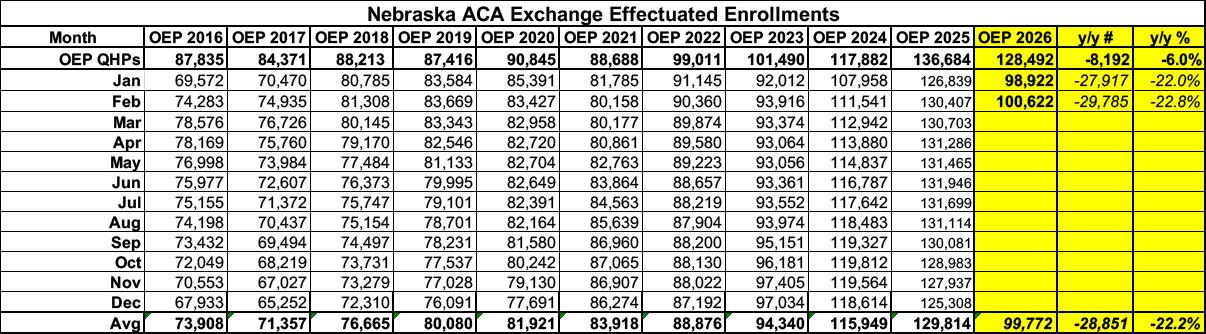
ACA exchange enrollment has dropped by 23% in Nebraska since Congressional Republicans allowed the enhanced federal subsidies to expire at the end of last year.
Initial signups during Open Enrollment were only down 5% vs. OEP 2025...but effectuated enrollment was 22% lower year over year in January and 23% lower as of February (although, interestingly, effectuated enrollment actually increased slightly from January to February both years).
That's nearly 30,000 Nebraskans who already lost coverage in just the first two months of the year...a number which has likely continued to climb since then.
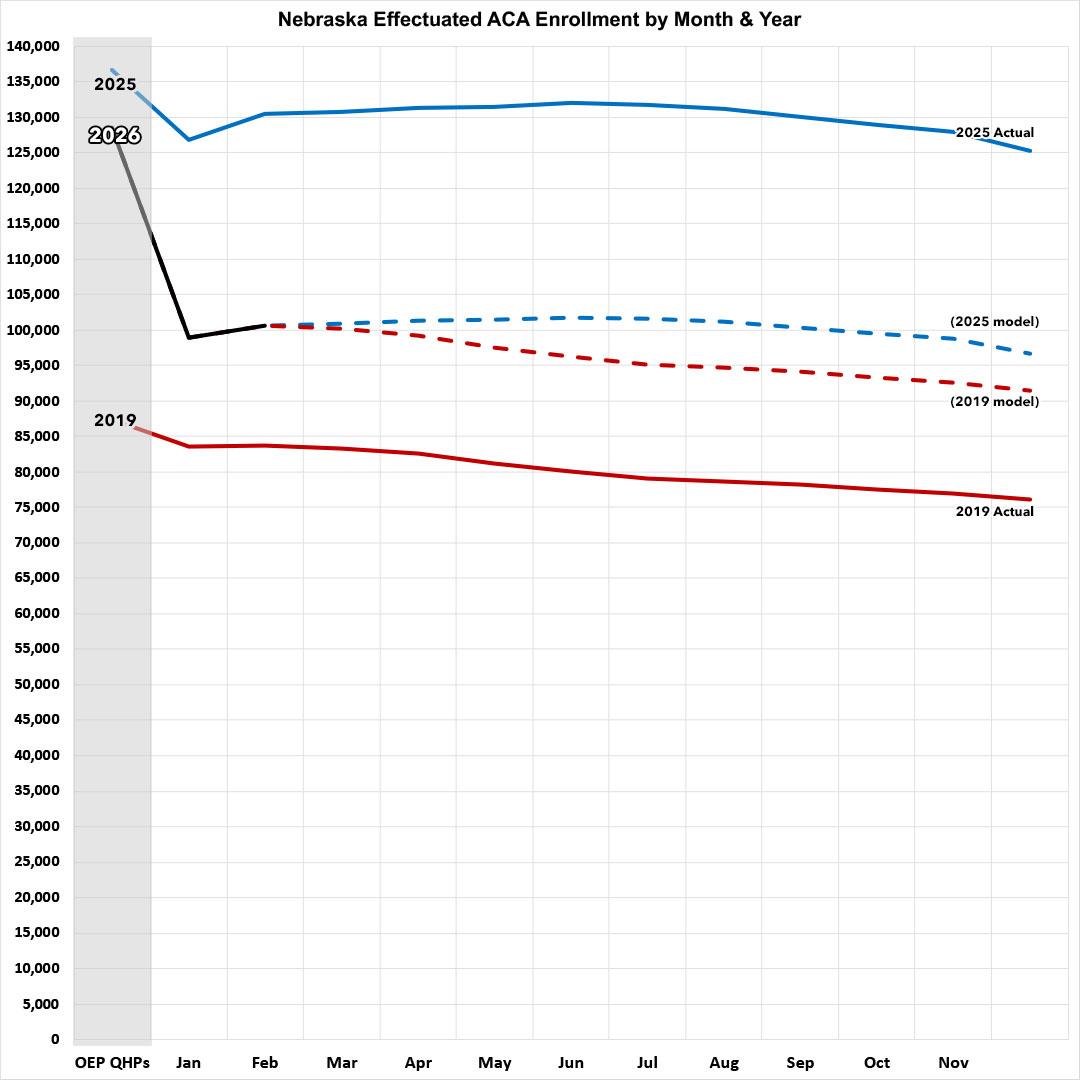
Here's what this looks like visually, with both 2025 and 2019 (the last pre-COVID year, which didn't include the enhanced subsidies) included for comparison:
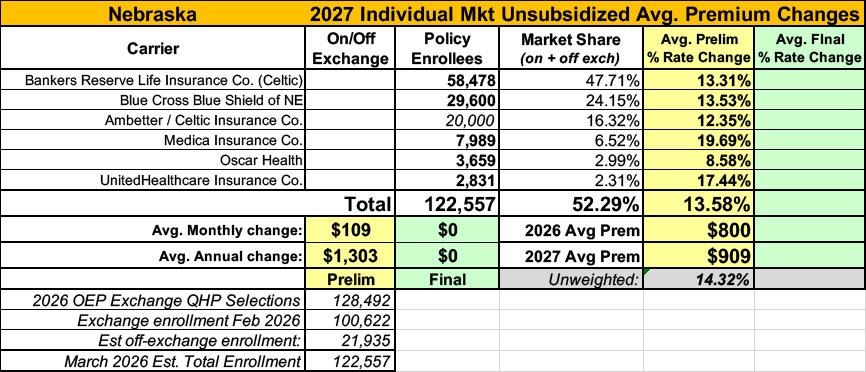
Looking ahead to 2027, the preliminary rate filings for both the individual and small group markets are now available via the federal Rate Review database:
BANKERS RESERVE/CELTIC INSURANCE CO:
Celtic Insurance Company is filing rates for the individual block of business, effective January 1, 2027. This document is submitted in conjunction with the Part I Unified Rate Review Template and the Part III Actuarial Memorandum.
This information is intended for use by the Nebraska Department of Insurance, the Center for Consumer Information and Insurance Oversight (CCIIO), and health insurance consumers in Nebraska to assist in the review of Celtic Insurance Company’s individual rate filing.
The results are actuarial projections. Actual experience will differ for a number of reasons, including population changes, claims experience, and random deviations from assumptions. In 2025, earned premium was $666.91 per member per month (PMPM). Incurred claims in 2025 were $524.11, or 78.6% of premium. Netting risk adjustment from the claims results in an estimated loss ratio (incurred claims net of estimated risk adjustment transfers, divided by earned premiums) of 85.3%. We expect unit costs to increase for 2027. Further, we have updated underlying experience for the single risk pool, expected administrative expense, and assumptions for federal risk adjustment. These factors, as well as changes to the assumed morbidity of the single risk pool and medical trend, result in a premium rate increase.
Medical trend, or the increase in health care costs over time, is composed of two components: the increase in the unit cost of services and the increase in the utilization of those services. Unit cost increases occur as care providers and their suppliers raise their prices. Utilization increases can occur as people seek more services than before. Additionally, simple services can be replaced with more complex services over time, which is known as service intensity trend. An example of service intensity trend would be the replacement of an X-ray with an MRI scan. Replacing the service with a more intense service causes the total cost of medical services to increase.
The proposed rate change of 12.3% applies to approximately 58,478 individuals. Celtic Insurance Company’s projected administrative expenses for 2027 are $94.20 PMPM. Administrative expense does not include $31.44 for taxes and fees. The historical administrative expenses for 2026 were $78.88 PMPM, which excludes taxes and fees. The projected loss ratio is 84.6% which satisfies the federal minimum loss ratio requirement of 80.0%.
BLUE CROSS BLUE SHIELD OF NEBRASKA:
Blue Cross and Blue Shield of Nebraska (BCBSNE) is setting new rates for its Individual ACA market business in Nebraska. The rate change will take effect January 1, 2027, and will impact an estimated 29,600 members. On average, rates will go up by 13.0% compared to 2026 individual rates. Depending on the network and plan, rate changes will range from an increase of 0.1% to 22.8%. Additionally, premiums will go up a bit each year as people get older, even if their plan rates stay the same.
BCBSNE used its own claims and enrollment data, and other publicly available information to set these rates. BCBSNE expects the new rates to cover medical costs and result in a medical loss ratio (MLR) of 86.8%. This means 86.8 cents of every premium dollar will go towards members' medical expenses and improving health care quality. This MLR is higher than the ACA's minimum requirement of 80%. If the three-year average MLR falls below 80%, BCBSNE will refund the difference to policyholders as required by federal law.
Key Drivers Behind the Rate Increase
The proposed rate changes for 2027 are due to several important factors, including:
- Rising costs due to contractual changes in payments to healthcare providers.
- Rising medical and pharmacy costs due price inflation, changes in how often services are used and new treatments.
- Estimated changes in the market's health due to the expiration of the enhanced premium subsidies from the America Rescue Plan Act (ARPA).
- Changes in administrative costs, regulatory requirements, and changes in plan benefits.
All these factors have been considered in setting the new rates to ensure they are fair and stable for the market.
AMBETTER / CELTIC INSURANCE CO:
Reasons for Rate Increase(s):
The rate projections for 2027 have been updated from the previous year’s projections to reflect the most recent assumptions and information available.
The following provides a narrative description of the significant factors driving the proposed rate
increase for 2027.
- x x x x x x x x x x x x x x x x x x x x x x x x x x x x x x x x x x x x x x x x x x x x x
(unfortunately, this has been redacted)
MEDICA INSURANCE CO:
14Medica Insurance Company (MIC) is requesting a rate change for its Affordable Care Act (ACA) individual market business in Nebraska. The rate change will take effect on January 1, 2027 and will impact an estimated 7,989 members. The average rate change will be 19.7% and will result in rate changes that vary across plan designs. This includes changes to the costs of care. MIC uses 2025 data from Nebraska to develop premium rates.
This data includes estimates of changes to the below through 2027:
- Population Medica expects to insure
- Cost of medical services
- Cost of pharmacy services
- Taxes and fees
The significant factors that impact the rate change include those listed above. Claim costs per member per month are expected to change from $674.88 in 2025 to $962.53 in 2027.
2) Financial Experience of the Product
In 2025, 103% of premium dollars went towards medical services after taxes and fees were removed. Under the ACA, individual products are required to pay at least 80% of premium dollars, after taxes and fees are removed, toward medical services. For 2027, MIC is expecting that 89% of premium dollars will be spent on medical services.
3) Changes in Medical Service Costs
Medical cost changes, in both number of services and costs of services, make up the largest increase to MIC’s premium rates. Impacts due to better rates with hospitals and doctors and reviewing recent experience also aid in determining premium changes. Finally, relationships with providers are helping to improve premium rates through a lower overall cost for care.
4) Changes in Benefits
MIC updates the plan designs offered each year, which impacts each plan’s cost-sharing (e.g. deductibles, copayments, etc.). These updates follow federal rules for how much of costs the insurance company will cover under that plan. Because these updates will vary between each plan, the rate changes will also vary by plan.
5) Administrative Costs and Anticipated Margins
MIC expects the cost to administer coverage per member per month (PMPM) for 2027 to be $88.60, which is higher than the 2026 value of $84.37. The main drivers of MIC’s administrative expenses are employee salaries and benefits, agent commissions, claims processing/IT, and clinical/network services.
OSCAR HEALTH:
The purpose of this document is to present rate change justification for Oscar Insurance Company, Inc (Oscar’s) Individual Affordable Care Act (ACA) products, with an effective date of January 1, 2027, and to comply with the requirements of Section 2794 of the Public Health Service Act as added by Section 1003 of the Patient Protection and Affordable Care Act (ACA).
Using in-force business as of June 2026, the proposed average rate increase for renewing plans is 8.6%. Rate increases vary by plan and range from 2.1% to 17.1% due to a combination of factors including shifts in benefit leveraging and cost-sharing modifications and network changes. This rate increase is absent of rate changes due to attained age. There are 3,659 current members impacted by this rate increase.
2. Reason for Rate Increase(s)
The significant factors driving the proposed rate change include the following:
Medical and Prescription Drug Infl ation and Utilization Trends
The projected premium rates reflect the most recent emerging experience which was trended for anticipated changes due to medical and prescription drug inflation and utilization.
Administrative Expenses, Taxes and Fees, and Risk Margin
Changes to the overall premium level are needed because of required changes in federal and state taxes and fees. In addition, there are anticipated changes in both administrative expenses and targeted risk margin.
Prospective Benefit Changes
Plan benefits have been revised as a result of changes in the Center for Medicare and Medicaid Services (CMS) Actuarial Value Calculator and state requirements, as well as for strategic product considerations.
Anticipated Changes in the Average Morbidity of the Covered Population
Changes to the overall premium level are needed because of anticipated changes in the underlying morbidity of the projected marketplace.
Anticipated Changes in the Network Configuration
Changes to the overall premium level are needed because of anticipated changes in the underlying network configuration and associated unit costs.
UNITEDHEALTHCARE INSURANCE CO:
UHIC is filing 2027 rates for individual products. The proposed rate change is 17.44% and will affect 2,831 individuals. The rate changes vary between 13.35% and 18.32%. Given that the rate changes are based on the same single risk pool, the rate changes vary by plan due to plan design changes.
Financial Experience of the Product
The premium collected in plan year 2025 was $25,699,357. Incurred claims during this period were $19,783,331 and UHIC expects payments of $5,239,827 for risk adjustment. The benefit claims ratio, or portion of premium required to pay medical claims, for plan year 2025 is 97.37%.
Changes in Medical Service Costs
There are many different healthcare cost trends that contribute to increases in the overall U.S. healthcare spending each year. These trend factors affect health insurance premiums, which can mean a premium rate increase to cover costs. Some of the key healthcare cost trends that have affected this year’s rate actions include:
- Increasing cost of medical services: Annual increases in reimbursement rates to healthcare providers, such as hospitals, doctors, and pharmaceutical companies.
- Increased utilization: The number of office visits and other services continues to grow. In addition, total healthcare spending will vary by the intensity of care and use of different types of health services. The price of care can be affected using expensive procedures such as surgery versus simply monitoring or providing medications.
- Higher costs from deductible leveraging: Healthcare costs continue to rise every year. If deductibles and copayments remain the same, a higher percentage of healthcare costs need to be covered by health insurance premiums each year.
- Impact of new technology: Improvements to medical technology and clinical practice often result in the use of more expensive services, leading to increased healthcare spending and utilization.
- Changes in market morbidity: Premiums reflect the expected increase in the average cost per member due to healthier members leaving the market now that enhanced APTCs were allowed to expire.
Changes in Benefits
Changes in benefits impact costs and therefore affect premium changes. Plan benefits are typically changed for one of three reasons: to comply with the requirements of the Affordable Care Act or state law, to respond to consumer feedback, or to address a particular medical cost issue to provide greater long-term affordability of the product.
The Affordable Care Act implemented requirements for the “value” that must be offered by plan designs in the Individual and Small Group markets. These are called “metal levels.” For a benefit plan to remain classified within a particular metal level from year to year, adjustments to deductibles, copayments or coinsurance are sometimes required. These adjustments impact the cost and therefore the premium increases for the plan.
Administrative Costs and Anticipated Margins
UHIC works to directly control administrative expenses by adopting better processes and technology and developing programs and innovations that make healthcare more affordable. We have led the marketplace by introducing key innovations that make healthcare services more accessible and affordable for customers, improve the quality and coordination of healthcare services, and help individuals and their physicians make more informed healthcare decisions.
Taxes and fees imposed by the state and federal government are significant factors that impact healthcare spending and must be included as additional administrative costs associated with the plans. These fees include Affordable Care Act taxes and fees which impact health insurance costs and need to be reflected in premium. Another component of premium is margin, which is set to address expected volatility and risk in the market.
The requested rate change is anticipated to be sufficient to cover the projected benefit and administrative costs for the 2027 plan year.
Note that the effectuated enrollment number for Ambetter/Celtic Insurance Co. is redacted, so I had to make an educated guess in order to run a weighted average rate hike...which comes in at 13.6%:
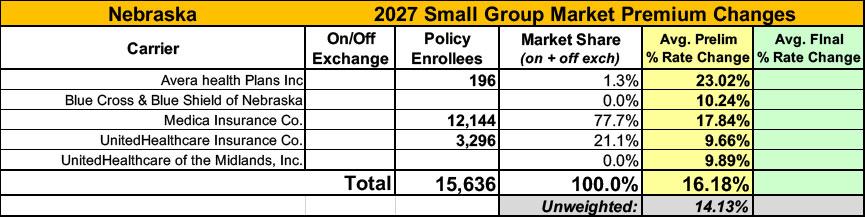
Meanwhile, the Nebraska small group market is looking at a non-weighted average rate increase of 14.1% (the effectuated enrollment for BCBSNE and UHC of the midlands is redacted, preventing a weighted average):
Advertisement


