


2027 Rate Changes - New Hampshire: +17.7% indy market; +12.4% sm. group market
Tue, 08/25/2026 - 2:36pm
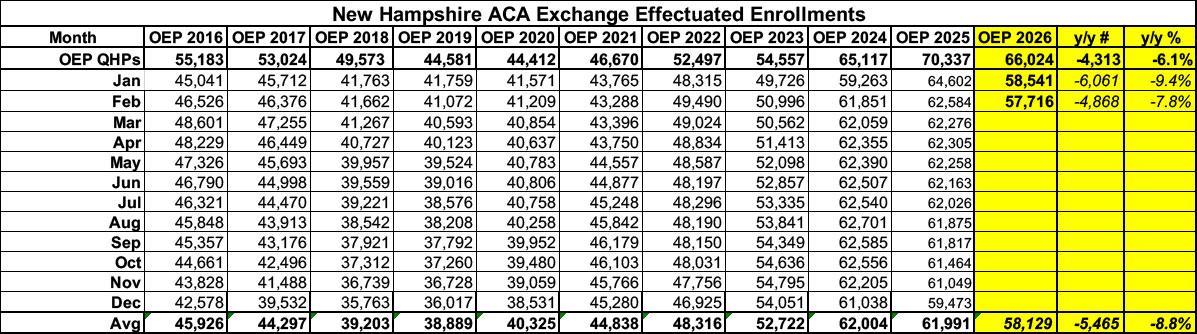
ACA exchange enrollment has dropped by ~8% in New Hampshire since Congressional Republicans allowed the enhanced federal subsidies to expire at the end of last year.
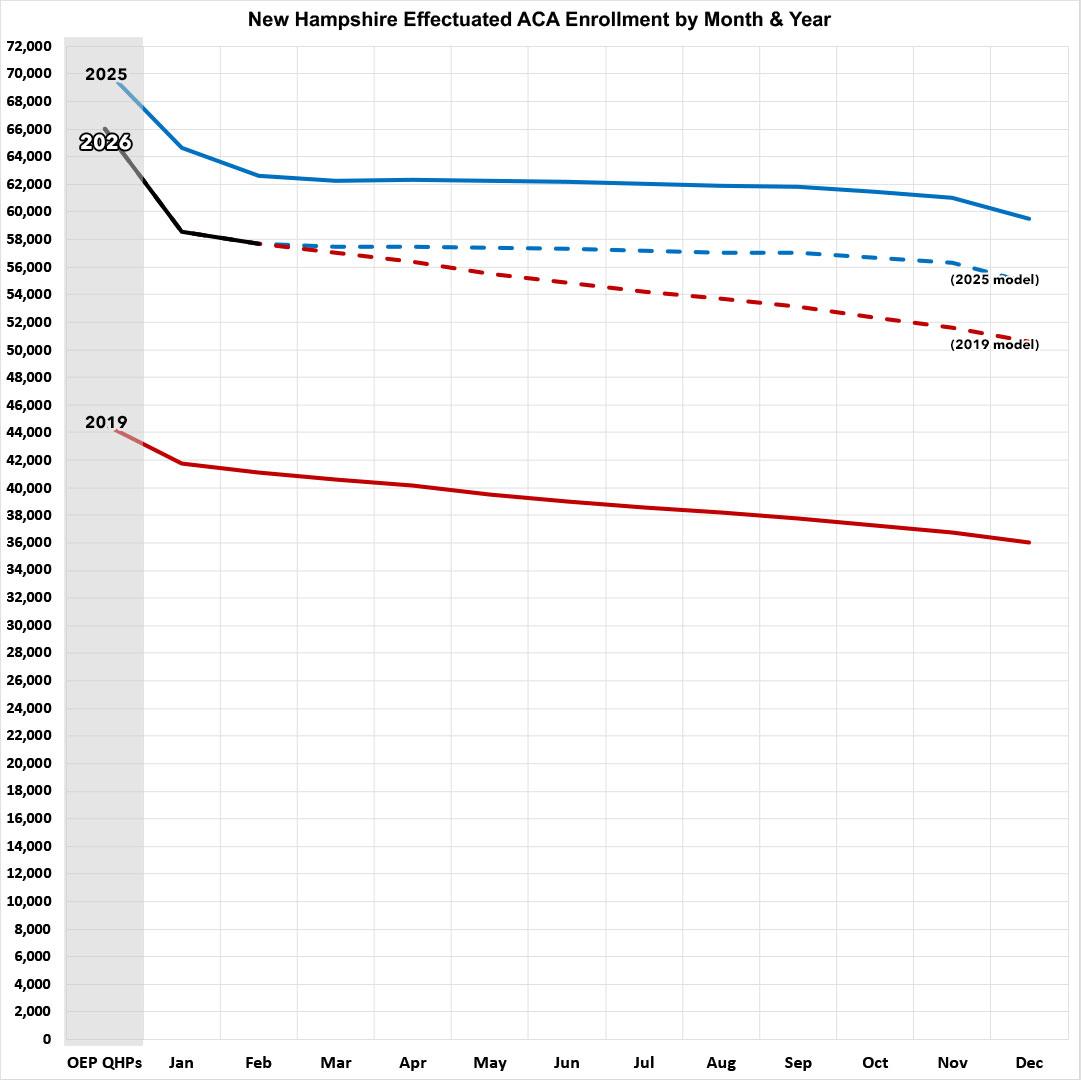
Initial signups during Open Enrollment were down ~6% vs. OEP 2025...but effectuated enrollment shrank by a bit more in the first two month sof the year...although interestingly it actually nudged back up a smidgen in February relative to a year earlier.
Here's what this looks like visually, with both 2025 and 2019 (the last pre-COVID year, which didn't include the enhanced subsidies) included for comparison:
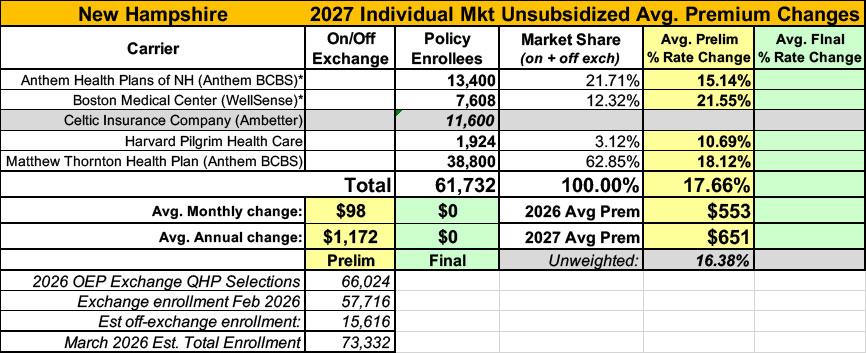
Looking ahead to 2027, the preliminary rate filings for both the individual and small group markets are now available via the federal Rate Review database:
ANTHEM HEALTH PLANS OF NH:
Anthem Health Plans of New Hampshire, Inc., also referred to as Anthem, has made an application to the New Hampshire Insurance Department for premium rate changes for its fully ACA-compliant individual health plan products. This increase will impact approximately 13,400 New Hampshire insured members renewing on 1/1/2027 with Anthem. At the individual plan level, rate increases range from 8.4% to 25.3%. A subscriber’s actual rate could be higher or lower depending on the age characteristics, dependent coverage, and other factors. Anthem expects some members to have an increase over 15%.
Financial Experience
Anthem expects the proposed rate increase will cover projected medical trends and yield a medical loss ratio of 84.8%, meaning about eighty-five cents of each premium dollar are expected to go towards covering our members’ medical expenses and improving health care quality. This projected MLR of 84.8% exceeds the minimum MLR requirement of 80% as defined in the Affordable Care Act (ACA). In the event Anthem’s MLR is less than the Federal required minimum for a three-year period, Anthem will refund the difference to policyholders, consistent with federal regulations.
Drivers of Rate Increase
The primary drivers of premium increases are associated with increased cost of benefit expense for this ACA‐compliant block. Increased cost of benefit expense is driven by increases in the price of services primarily from hospitals, physicians, and pharmacies, coupled with members increasing their use of health care services, also called “utilization.” Increases in the price of services are driven by technological advances, new specialty medications, and a variety of other factors. Increased utilization is driven by member level utilization and selection patterns in the guaranteed issue ACA market.
Efforts to Control Costs
Anthem is committed to working to hold down the cost of insurance and price the individual ACA market for long term sustainability. We continue to explore innovative collaboration with providers and negotiate deeper discounts at our hospitals. We provide members with tools to make informed decisions about where and how to receive treatment. Despite these efforts to moderate the cost of insurance, the cost of benefit expense in the individual ACA market has continued to outpace premium on a large scale due to the drivers described above. In light of emerging costs, 2027 premium increases are needed to price Anthem’s ACA-compliant individual health plan products for long term sustainability.
BOSTON MEDICAL CENTER (WELLSENSE):
Boston Medical Center Health Plan (WellSense) is offering 13 plans for PY2027. Plans 13219NH0010001 – 13219NH0010011 were also offered in PY2026 and plans 13219NH0010012 – 13219NH0010015 are new plan offerings for PY2027. Renewing plans have proposed rate increases for PY2027 ranging from 17.0% to 41.2%. As of March 2026, there are 7,608 members enrolled in these plans who would be impacted by this rate filing if they were to purchase the same plan in 2027.
Financial Experience of the Product
For PY2025, WellSense had total incurred claim expenses of $13.9 million and total premium of $18.8 million. The loss ratio, defined as the proportion of projected claims (net of reinsurance) relative to projected premium (net of risk adjustment), was 99% as reported in the Unified Rate Review Template.
For PY2027, WellSense is projecting total incurred claim expenses of $30.5 million and total premium of $53.5 million. The projected loss ratio is 75.5% using the definition in the Unified Rate Review Template. Under the federal definition that accounts for the impact of quality improvement expenses, taxes, and fees, the projected loss ratio is 88.3%.
Changes in the Medical Service Costs
The primary component of the rate increase is annual medical cost trend. Both utilization of healthcare services and the cost for healthcare charged by providers typically increase over time.
4. Changes in Benefits
Benefit designs are not a major driver of rate changes for 2027.
5. Administrative Costs and Anticipated Margins
The PY2027 administrative and margin retention components have been adjusted to anticipated 2027 levels, driving a small increase to 2027 premium.
HARVARD PILGRIM HEALTH CARE:
Scope and range of the rate increase: Harvard Pilgrim Health Care (HPHC) is filing rates for Individual policyholders renewing in the first quarter of 2027. For existing plans, annual rate increases by plan range from 6.4% to 19.9%, before the impact of demographic changes. Our expected average rate increase for renewing policyholders is 10.7%. There are currently 1,249 policyholders and 1,924 members with HMO products that will be impacted by the filed rate increases. Rate increases vary by plan due to changes in benefit design that vary by plan, updated underlying benefit pricing assumptions, and updated Silver benefit pricing assuming CSR will not be funded. Increases will also vary depending on members’ age.
Drivers of the Rate Increase
The key drivers of the rate increase include:
- • Medical Trend: A key driver of health insurance premium increases year-over-year is medical trend, which is comprised of inpatient, outpatient, and physician services. Medical trend includes both increases in the cost of the services provided by hospitals and physician groups and increases in the utilization and severity of these services by our members.
- For 2027, Harvard Pilgrim expects there to be continued upward pressure on medical cost increases, driven by the higher inflationary environment and labor shortages that have led to providers requesting higher rates of reimbursement. While Harvard Pilgrim expects to successfully partner with hospitals and physicians across the state to moderate these cost increases, and continue to make quality care accessible for all, the increases are expected to be above recent historical levels.
- Harvard Pilgrim has also seen a large increase in medical utilization trends. Utilization has increased across multiple categories of services and is not driven by any single event or service type.
- Pharmacy Trend: Pharmacy spend continues to put significant upward pressure on overall claim trend, particularly for brand drugs such as Immunomodulators, and high cost specialty drugs, and this is expected to continue in 2027.
- Overall inflation is also contributing to increasing administrative expenses. Under the Affordable Care Act, at least 80% of premium must be used for medical expenses (otherwise, a rebate is paid to subscribers). Harvard Pilgrim expects to comply with this requirement in 2027.
- Offering more plans on exchange: In response to the NBPP eliminating the limits on plans offered on exchange, off exchange only Silver plans from 2026 will be offered on exchange for 2027. This requires these plans to be subject to Silver loading as HPHC assumes CSR subsidies will not be funded, which increases the premium by 10.3%.
HPHC’s Strategy to Control Costs
Harvard Pilgrim Health Care is committed to delivering increased access to high-quality care and lowering out of pocket costs for members, wherever possible. To support these objectives, we continue to focus on the following areas:
- Preventive care to keep our health plan members thriving and health care costs lower
- Active management of pharmacy programs, including timely policy changes to control the cost of certain medications, as well as ensure access to effective, alternative therapeutic solutions
- Provider collaboration focused on quality-driven goals and improved health outcomes
- Coordinated support for members with chronic conditions and diseases through our integrated care team
- Better identification of unmet needs and care gaps to drive increased adherence and utilization of preventive care
- Maintaining a focus on reducing fraud, waste, and abuse
- Streamlining internal health plan operations to improve customer and member experience, while increasing overall plan efficiencies
- Frequent review of medical policy, plan designs and coverage policies to deliver equitable access to all health plan members throughout the communities we serve
Continuing to find ways to lower health care costs while providing enhanced value to our customers through our products and services is a keystone to Harvard Pilgrim’s long-term strategy.
MATTHEW THORNTON HEALTH PLAN:
Matthew Thornton Health Plan, Inc., also referred to as Anthem, has made an application to the New Hampshire Insurance Department for premium rate changes for its fully ACA-compliant individual health plan products. This increase will impact approximately 38,800 New Hampshire insured members renewing on 1/1/2027 with Anthem. At the individual plan level, rate increases range from 12.4% to 24.7%. A subscriber’s actual rate could be higher or lower depending on the age characteristics, dependent coverage, and other factors. Anthem expects some members to have an increase over 15%.
Financial Experience
Anthem expects the proposed rate increase will cover projected medical trends and yield a medical loss ratio of 85.3%, meaning about eighty-five cents of each premium dollar are expected to go towards covering our members’ medical expenses and improving health care quality. This projected MLR exceeds the minimum MLR requirement of 80% as defined in the Affordable Care Act (ACA). In the event Anthem’s MLR is less than the Federal required minimum for a three-year period, Anthem will refund the difference to policyholders, consistent with federal regulations.
Drivers of Rate Increase
The primary drivers of premium increases are associated with increased cost of benefit expense for this ACA‐compliant block. Increased cost of benefit expense is driven by increases in the price of services primarily from hospitals, physicians, and pharmacies, coupled with members increasing their use of health care services, also called “utilization.” Increases in the price of services are driven by technological advances, new specialty medications, and a variety of other factors. Increased utilization is driven by member level utilization and selection patterns in the guaranteed issue ACA market.
Efforts to Control Costs
Anthem is committed to working to hold down the cost of insurance and price the individual ACA market for long term sustainability. We continue to explore innovative collaboration with providers and negotiate deeper discounts at our hospitals. We provide members with tools to make informed decisions about where and how to receive treatment. Despite these efforts to moderate the cost of insurance, the cost of benefit expense in the individual ACA market has continued to outpace premium on a large scale due to the drivers described above. In light of emerging costs, 2027 premium increases are needed to price Anthem’s ACA-compliant individual health plan products for long term sustainability.
CELTIC INSURANCE CO:
Meanwhile, Ambetter Health (aka Centene) is pulling out of the New Hampshire market entirely:
Ambetter Health has announced that it will no longer offer healthcare plans on the health insurance marketplace in New Hampshire starting next year.
According to data from the New Hampshire Insurance Department, as of June, over 11,600 people are enrolled in Ambetter Health plans. After Anthem Blue Cross Blue Shield New Hampshire, Ambetter Health is the second largest provider on the health insurance marketplace in the state, with roughly 20% of participants in the marketplace having plans with the health carrier.
(Note: Matthew Thornton Health Plans is actually a division of Anthem BCBS)
Statewide, the weighted average 2027 rate increase being requested by the four remaining carriers is around 17.7%.
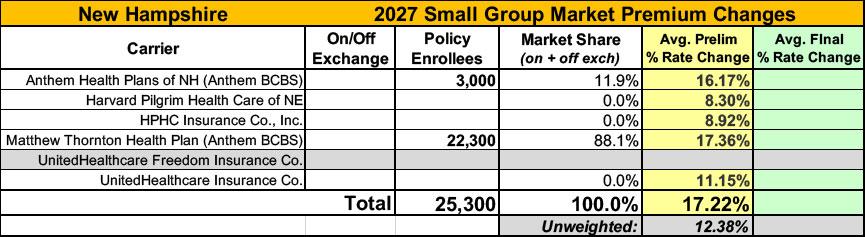
As for the small group market, it looks like one of UnitedHealthcare's two divisions is dropping out of that market, while the remaining five are requesting unweighted average premiums increases of 12.4%:
Advertisement


