


New Jersey: Effectuated ACA enrollment down 11.5% y/y; at least 57,000 have already lost coverage
Tue, 04/21/2026 - 12:46pm
From the New Jersey Dept. of Banking & Insurance:
Cost Increases from Washington’s Inaction Drives nearly 70,000 New Jerseyans to Drop Health Coverage since January
Expiration of Federal Subsidies Increase Health Care Costs for Working and Middle-Class New Jerseyans
Residents Urged to Stay Covered to Protect Their Health and Avoid Higher Out-of-Pocket Health Care Costs
TRENTON — -- Inaction by the Trump Administration and Congress to extend federal enhanced premium tax credits for consumers purchasing coverage through health insurance marketplaces under the Affordable Care Act has resulted in nearly 14% of those initially enrolled in health plans through Get Covered New Jersey to drop their coverage. As of April 15, 2026, total enrollment on the State Exchange stood at 440,362 – reflecting a net loss of 68,830 enrollees since the end of Open Enrollment.
Get Covered New Jersey, the State’s Official Health Insurance Marketplace, ended Open Enrollment for the 2026 plan year on January 31, with enrollment at 509,192, down slightly from the 513,217 enrolled for the 2025 plan year. However, as this year’s premiums came due, like many states across the country, New Jersey has seen tens of thousands of enrollees lose their 2026 coverage due to nonpayment of the higher premiums.
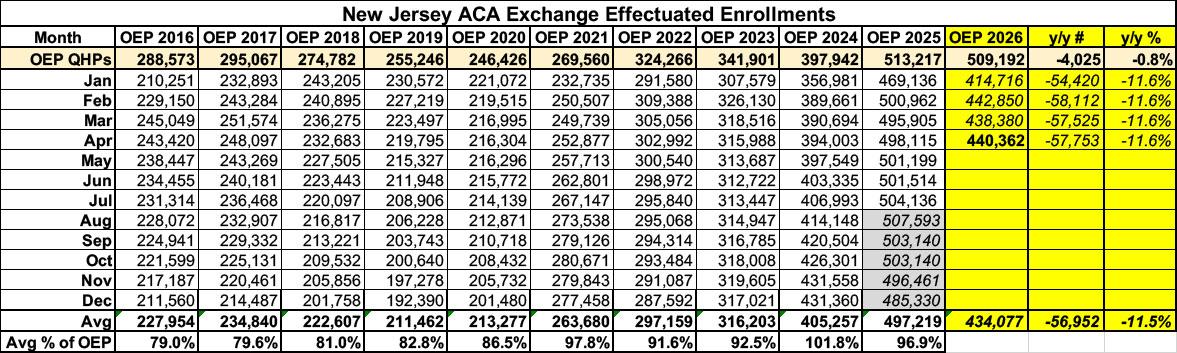
While the situation is ugly, I have to be intellectually honest here: The true measure of ACA healthcare coverage enrollment isn't how many people selected policies, it's how many actually have those policies in effect, and by that measure it isn't quite as bad as the press release makes it out to be: Effectuated enrollment as of April is "only" around 57,000 lower than it was in April 2025, or down around 11.6% instead of 14%. They didn't provide the effectuated numbers for January, February or March, but I'm going to assume that they were down by a similar percentage, like so:
“Across the board, we are seeing costs skyrocket for New Jersey families as a direct result of the federal government’s mismanagement. While New Jersey is committed to addressing health care costs, Washington has chosen to drive up health insurance prices, resulting in more New Jerseyans losing coverage. These decisions have real consequences for our communities,” said Governor Mikie Sherrill.
“We are seeing the heartbreaking consequences of the federal government’s failure to extend the enhanced premium tax credits for tens of thousands across the Garden State,” said Acting Commissioner Susan Ochs. “These individuals and families will now be at risk of forgoing important preventative care and left to rely on costly emergency services that they may not be able to afford.”
Among those who are covered, many New Jerseyans have chosen to “buy down” from Silver plans to Bronze plans that have lower premiums but much higher out-of-pocket costs. The Marketplace plans offered through Get Covered New Jersey are categorized into three types (or “metal levels”): Bronze, Silver, and Gold. In plan year 2025, approximately 83% of the enrollees who actively shopped for a plan enrolled in a Silver plan, compared to plan year 2026 where active Silver selections fell to 68%. Active Bronze selections increased from 16% for plan year 2025 to 31% for plan year 2026. The percentage of consumers receiving financial help to pay $10 a month or less for coverage fell from 48% for the 2025 plan year to 11% for plan year 2026.
I looked at the metal level shift and financial help breakout in more detail in my last New Jersey post.
Additional changes proposed by the federal government, if enacted, would create further barriers to enrollment and push residents to inadequate coverage, Acting Commissioner Ochs said, noting that the Department, in addition to the New Jersey Attorney General’s Office, had submitted a comment letter in response to a proposed rule by the U.S. Department of Health and Human Services. The proposed rule is in addition to the federally imposed change to shorten the annual Open Enrollment Period for coverage to nine weeks for upcoming years. Consumers enrolling in coverage through Get Covered New Jersey previously had three months to enroll.
Get Covered New Jersey remains the only place where consumers can access state and federal financial help to lower the cost of monthly premiums. Eight in 10 people enrolling in a health plan at Get Covered New Jersey qualify for financial help. Get Covered New Jersey continues to offer comprehensive coverage with health plans that cover preventive services, emergency services, prescription drugs, prenatal and pediatric care, and more. No one can be denied coverage due to a pre-existing condition. While the Open Enrollment period has now closed, residents can still enroll and receive financial help if they experienced a major life event, such as marriage, pregnancy, or a move that qualifies them for a Special Enrollment Period.
Federal and state subsidies remain available for those who qualify. New Jersey has made available state subsidies, called NJ Health Plan Savings, to qualifying residents with household incomes up to 600% of the Federal Poverty Level. In 2026, an individual with an income of up to $93,900 and a family of four who makes up to $192,900 can receive state subsidies to lower the costs of health coverage. From plan year 2021 to plan year 2026, New Jersey has invested over $1 billion in state support for Get Covered New Jersey consumers.
What might this look like for the rest of the year?
Once again: While plan selections only dropped slightly during Open Enrollment in New Jersey this year (by around 0.8%), effectuated enrollment is already nearly 12% lower. Here's what the rest of the year would look like assuming average effectuated enrollment follows the same pattern as it did last year (2025) vs. the last pre-COVID year (2019):
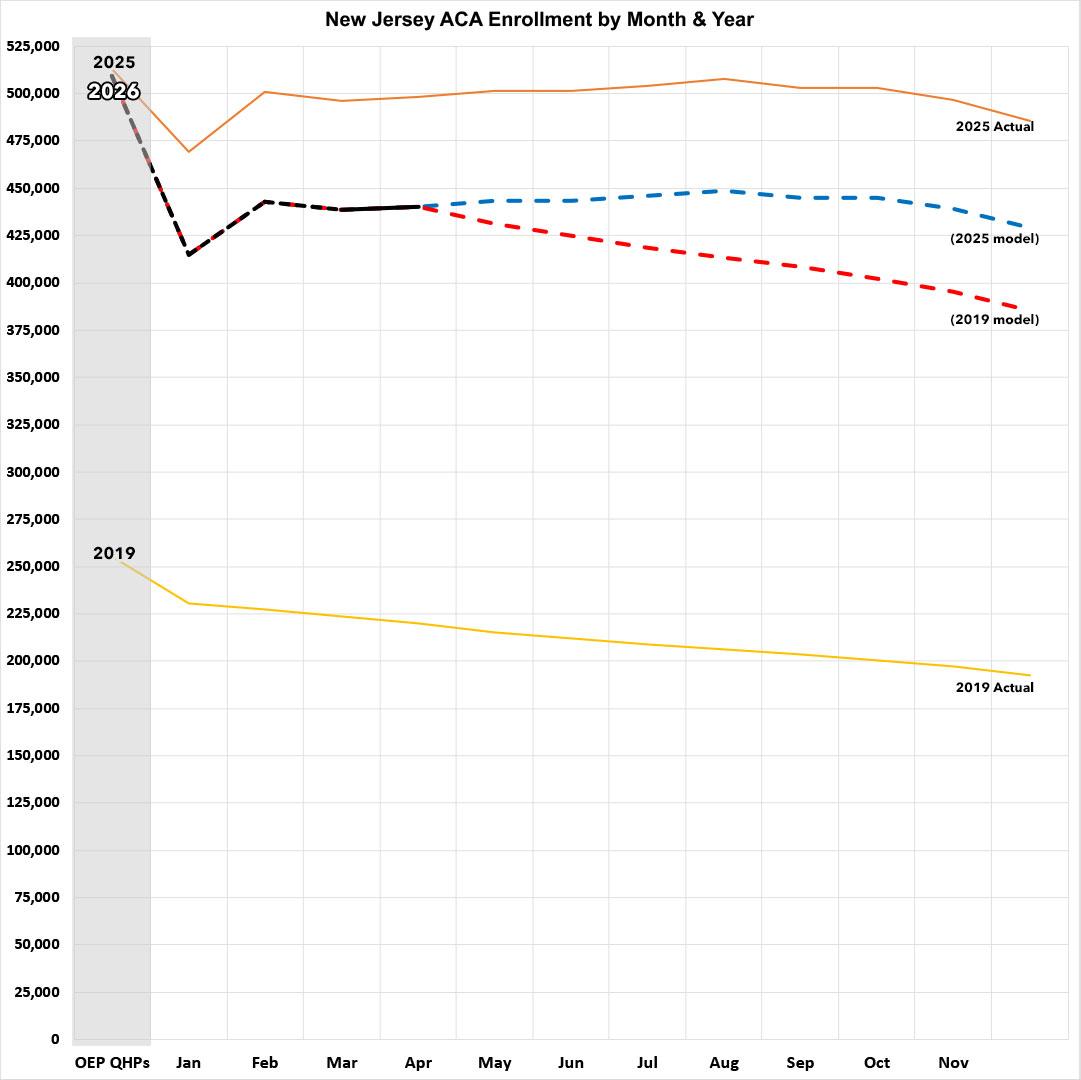
- If the rest of the year follows the 2025 pattern, effectuations will end December at around 429,000 and will average around 440,000 for the year...down 11.6% compared to 2025.
- If the rest of the year follows the 2019 pattern, effectuations will be at around 385,000 by December, and the average for the year will be around 418,000...down 15.9% y/y.
Important: As I mentioned regarding Colorado, Massachusetts & California: New Jersey is also one of the dozen or so states which have implemented state-based subsidies or other specific policy measures to help mitigate the damage caused by the enhanced federal tax credits expiring back in December.
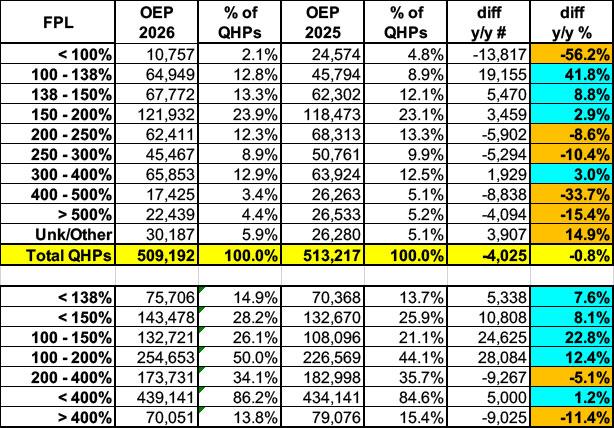
In New Jersey's case, as noted in the press release, they provide a hard dollar amount per month for enrollees earning up to 600% of the Federal Poverty Level (FPL), ranging from $20 - $100/month per enrollee. The table below shows the year over year plan selection (not effectuated enrollment) change at different income brackets...enrollment basically fell off a cliff below 100% FPL (mainly due to the Trump Regime banning documented immigrants living in the U.S. for less than 5 years from federal subsidy eligibility), and also dropped substantially over the 400% FPL threshold due to that population also no longer being eligible for tax credits.
Between 100 - 400% FPL, it was more of a mixed bag...enrollment from 100 - 200% FPL actually increased by about 12%, while it dropped by about 5% from 200 - 400% FPL.
Advertisement


