Whoa. This is a very big deal here in the Wolverine State for a lot of reasons, both economic and political. Via the Detroit Free Press:
For years, Blue Cross and Blue Shield of Michigan operated an illegal monopoly, violating state and federal antitrust and consumer protection laws to drive up health insurance premiums while limiting reimbursements to medical providers and making it more difficult for Michiganders to access quality health care, state Attorney General Dana Nessel alleges in a new, landmark lawsuit.
Calling it "arguably the most consequential antitrust case ever filed by a state against a health insurance company," Nessel sued Michigan's largest insurer Thursday, Oct. 8, in U.S. District Court in Detroit.
About a month ago, Donald Trump announced another one of his shameless voter-bribe attempts in a desperate attempt to salvage what's expected to be a disastrous midterm election for Congressional Republicans:
RETURNING BIDEN OVERCHARGES TO WORKING FAMILIES: Today, President Donald J. Trump announced that the federal government will return to the American people hundreds of millions in Obamacare overcharges, collected by the Biden Administration, by issuing refunds of $500 per person to nearly 1 million Americans in 30 states. Today’s actions directly refund the Americans most exposed to the higher costs imposed by the Biden Administration’s gross mismanagement of Obamacare.
Thirteen years ago, during the very first ACA Open Enrollment Period, Oregon was one of 15 states which attempted to operate their own fully state-based marketplace SBM) under the new law, calling it "Cover Oregon."
Cover Oregon poised to switch to federal insurance exchange
Alex Pettit, the state's top information-technology official, recommended Cover Oregon move to the federal exchange at an advisory committee meeting Thursday.
Oregon should pull the plug on the beleaguered Cover Oregon health insurance exchange and switch to the federal exchange, a technological advisory committee recommended Thursday.
The move is considered almost certain to be adopted by the Cover Oregon board, which meets Friday.
About 200,000 Virginians will be eligible to tap into new state funding meant to offset costs for insurance through the state’s Affordable Care Act exchange, starting in November.
This means that participants could save about 70% on their monthly premium, after state lawmakers and Gov. Abigail Spanberger approved $150 million dollars for it in the state budget late last month.
The move comes after federal funding shifts triggered by Congress’ failure to renew expiring ACA subsidies. Thousands of Virginians have dropped their coverage so far this year as premiums have shot up.
Virginia’s Health Benefit Exchange estimates that about 100,000 Virginians have lost their health coverage this year as a result of higher premiums, according to a new press release.
Connecticut residents can begin enrolling October 23
Access Health CT (AHCT), Connecticut’s official health insurance marketplace, today announced the 2027 Open Enrollment Period will run from Oct. 23 through Jan. 15. Open enrollment is the time for Connecticut residents to shop, compare, and enroll in or renew their health and dental insurance.
The date that customers enroll determines when coverage starts.If customers enroll on or before Dec. 15, 2026, coverage will start Jan. 1, 2027. If they enroll between Dec. 16, 2026 and Jan. 15, 2027, coverage will begin Feb. 1, 2027.
In recent years, open enrollment for AHCT has run from Nov. 1 through Jan. 15. New federal changes had required marketplaces to limit their Open Enrollment Periods to nine weeks and end by Dec. 31 but this is now subject to a lawsuit challenging the change.
Estimate & Explore is now available, giving Coloradans more time to review their health coverage options before Open Enrollment begins.
Dear Friends and Partners,
Every year, Open Enrollment gives Coloradans an opportunity to evaluate their health coverage and make decisions about the year ahead. For some people, that process is straightforward. For others, it can feel overwhelming.
Health coverage decisions often involve balancing premiums, deductibles, provider networks, prescription drug coverage, and other factors that affect both a household budget and access to care. Those decisions become even more important when costs are rising and families are taking a closer look at their finances.
SACRAMENTO, Calif. — Covered California Executive Director Jessica Altman issued the following statement on today’s announcement from the federal administration:
“Today's announcement from the federal administration about fraud on the federal ACA marketplace does not affect any of the 1.785 million Californians who are connected to health insurance through Covered California. Families across our state can rest assured that their health coverage will not be impacted.
I don’t write about specific political campaign ads very often, but this one happens to be directly related to the healthcare field (namely, medical debt), so it seemed to merit a few words.
About a week ago, Adam Hamilton, the Democratic nominee for U.S. Senate in Kansas, came out with a new TV ad featuring one of the former patients who was once sued by his Republican opponent, incumbent Senator (and former OB/GYN) Roger Marshall (the ad starts at 2:26 in the clip posted above).
In the ad, the woman, Meischa Zimmerman, says:
“One evening I see lights. I open the door, and it’s a police officer. They arrested me because I didn’t make a $50 payment to Roger Marshall. I was 8 months pregnant and I said please, do not handcuff me in front of my 2-yr old daughter.
“Roger Marshall preyed on the low-income families of Kansas. The healthcare system is broken…but not for Roger Marshall. He’s absolutely profiting from it.”
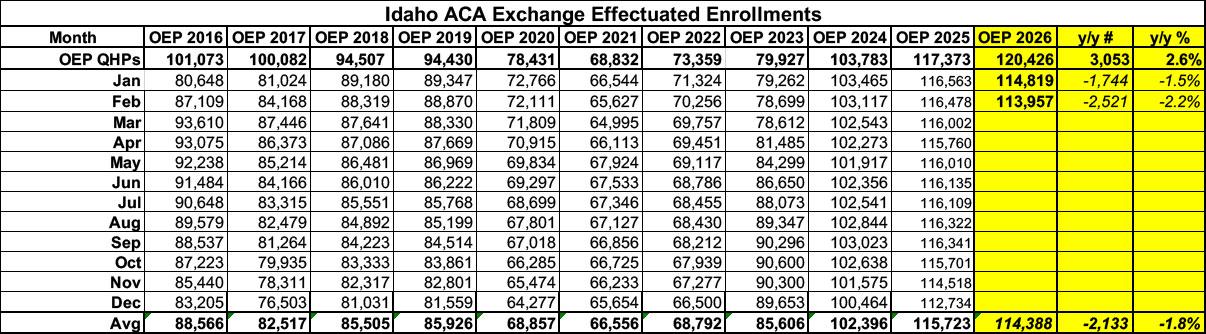
Idaho is one of a handful of states where plan selections during the 2026 Open Enrollment Period actually increased year over year, by around 2.6%, in spite of the enhanced federal subsidies expiring back in December.
Two months into the year, however, effectuated enrollment is actually down slightly (by around 2.2%, or roughly 2,500 enrollees).
Here's what this looks like visually, with both 2025 and 2019 (the last pre-COVID year, which didn't include the enhanced subsidies) included for comparison:
Individual Market Proposed Average Rate Changes for Plan Year 2027
The summary table below provides an overview of the proposed average rate changes from 2026 in the individual health insurance market, as reported by the insurers.
It is important to note these are the initial rates proposed by the insurers and filed with the Departments. Rates are subject to review and approval by the Departments, and the final approved rates may vary from these proposed rates for many reasons.
Additionally, the actual rate change a consumer will experience in 2027 can vary from the average – with factors such as specific plan, geographic rating area, and age playing a major role.